Oct 24, 2026Buying Guides
Shooting Range Rubber Bullet Traps, Backstops and Flooring: What Actually Works
Rubber bullet traps, ballistic blocks, bullet collection mats and range flooring for indoor and outdoor ranges — what each product does and how to spec a range that contains rounds properly.
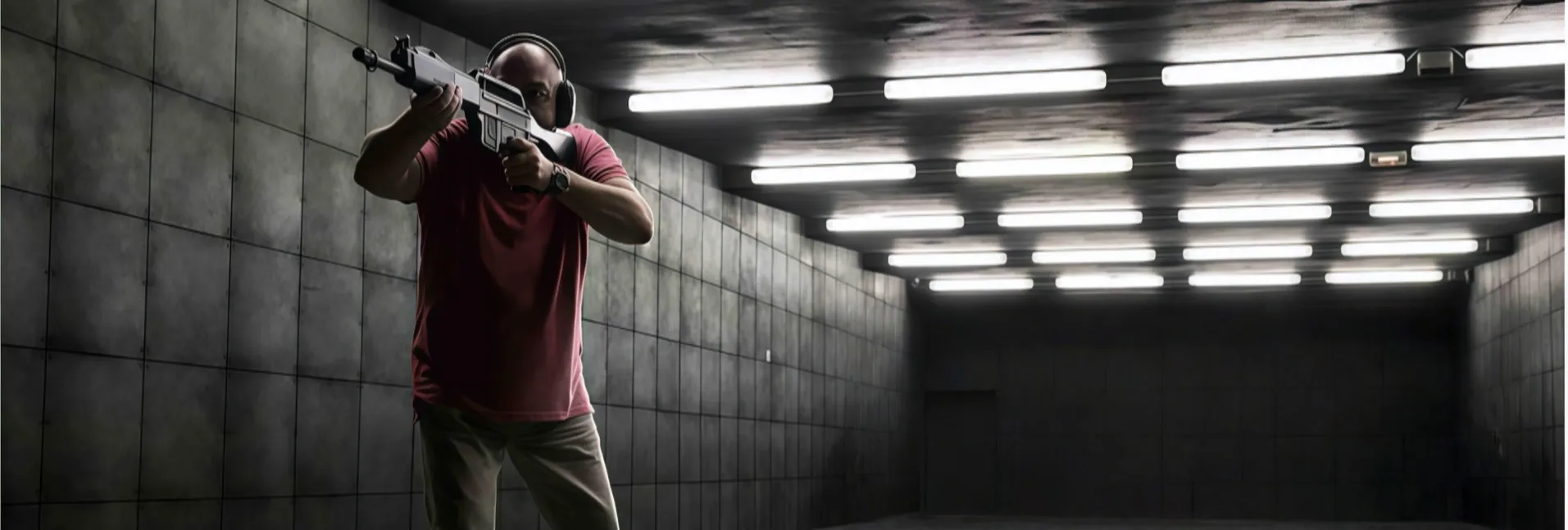
A shooting range is a place where every surface has a job. The floor has to swallow bullet fragments. The backstop has to stop projectiles. The walls have to protect whatever is behind them. Rubber — dense, elastic, repairable — is the material the industry settled on for all three.
This guide covers the products a range project actually needs, the difference between a bullet collection mat and a ballistic block, what thickness and density mean in practice, and the questions that sort a serious supplier from a reseller.
How a rubber range system fits together
A complete rubber range installation combines four product groups:
- Ballistic blocks and panels form the bullet trap / backstop behind targets — they stop the projectile and contain the impact.
- Bullet collection mats line the floor under and around the target area — they catch spent bullets and fragments, stop ricochets off hard floors, and simplify lead recovery.
- Protection and peripheral mats cover walls and non-target surfaces, buffering stray impacts and fragments.
- Range flooring gives the standing and walking surface — non-slip, dense, quiet underfoot.
Everything is specified by the energy of the rounds being fired. That single factor decides density and thickness more than any other.
Ballistic blocks: stopping the round
High-density rubber blocks are the workhorse of range backstops. A typical module is 500×300×300 mm of high-density rubber. The block absorbs and contains the projectile, dissipates the energy — and, critically, can be rotated so a fresh impact surface is presented without replacing the block.
Interlocking ballistic blocks build a wall or trap panel without mortar or glue, which means a damaged section can be swapped out on site.
Block-and-steel combinations pair a rubber block with an AR500 steel backing plate (for example 508×914 mm modules) for high-energy applications where rubber alone would not contain the round. This is the common configuration for mobile and high-power rifle traps.
Rifle stands and target drones integrate with the same block system, letting range operators reposition targets without rebuilding the trap.
When a supplier quotes a "ballistic block," three numbers matter: density, module size, and whether it has a steel backing. A solid block and a block-and-steel trap are different products with different price points and different containment envelopes.
Bullet collection mats: the floor's job
The floor under and around the target area is where bullets end up — and a hard floor turns them into ricochets. Rubber bullet collection mats handle this:
- Fiber and porous-structure mats — for example, 500×500×25 mm EPDM fiber mats with interlaced fibers and internal porous structure — catch and hold spent bullets while the surface stays walkable. The fiber construction stops the projectile and keeps it from bouncing.
- High-density collection mats (500×500 or 1000×1000 mm at 15–50 mm) suit ranges with higher round counts and heavier calibers.
- EPDM rubber mulch tiles give a related option for outdoor ranges and berms, where the mulch surface integrates with an outdoor backstop.
The detail buyers miss: collection mats are not just impact absorbers, they are lead management. A mat that captures bullets cleanly makes lead recovery straightforward and keeps lead dust out of the air. Ask how the product behaves under repeated impact — it should contain the bullet, not tear open after a few thousand rounds.
Walls, protection mats, and the odor question
Peripheral protection mats (500×500×15–50 mm or 1000×1000 mm panels) cover side walls and baffles. They buffer stray impacts and fragments so the structure behind them stays intact.
Composite protective mats with a rubber-roll surface layer (e.g. 1000×500×25–30 mm) suit wall areas where a smoother, more finished surface is wanted alongside the impact layer.
Odor-free protective mats matter more in indoor ranges than almost anywhere else in this business. Recycled rubber can carry a persistent smell, and in a ventilated indoor range that smell becomes a member complaint. Odor-free EPDM constructions (available in 500×500 and 1000×1000 mm formats) are the right call for enclosed ranges — specify them for walls and floors from the start rather than retrofitting later. The same odor issue comes up in enclosed gyms, and we cover how to handle it there in our rolls vs tiles gym flooring guide. See the gym flooring odor section →
Indoor ranges should also treat lead dust and ventilation as a system. Floor and trap materials that are easy to vacuum and clean keep lead from migrating.
Range flooring: the standing surface
Ballistic floor tiles — dense rubber tiles at 500×500×15–50 mm — give the whole range a non-slip, fragment-resistant floor that doubles as low-level bullet containment.
High-density rubber rolls cover walkways, corridors, and the firing line where a seam-free, easy-to-clean floor is wanted.
Anti-fatigue behavior matters for staff who stand on the line for hours. You want a floor dense enough to be safe and elastic enough to stand on comfortably — density first, cushion second.
On claims: what deserves skepticism
Range products sit in a sensitive safety space, and this is where marketing language deserves the most scrutiny.
Ask for the test report on the exact product — including the caliber, velocity, and energy the block or mat is documented against. A verbal "stops rifle rounds" is not a specification.
Fire claims need the same treatment. Rubber is a hydrocarbon material; its natural behavior under fire is not the same as inherently non-combustible products. Any fire-performance claim needs a verifiable test report for your specific product and your local code requirements. Let your architect or authority decide what the range needs — treat unverified fire claims as noise, not signal.
Beware identical photos with different specs. If the same product image appears under three thicknesses at three prices, you are comparing marketing pages, not products.
What a supplied range actually looks like
Two project types come up repeatedly in our export work:
- UK shooting range: an indoor club range supplied with rubber bullet collection mats, ballistic floor tiles, and wall protection panels — the full floor-and-trap package rather than a single mat.
- US shooting range: a similar indoor setup with high-density collection mats and interlocking ballistic blocks, specified around the round types the range hosts.
These are the standard configurations we ship and install with international clients: the trap, the floor, and the wall protection specified together, so nothing in the containment system is an afterthought. If your range shares space with a fitness area — many clubs combine both — the gym flooring guide explains how to spec the non-range zones. Read the gym flooring guide →
8 questions to ask a range flooring supplier
- What round types and muzzle energies is this product tested against — and where is the test report?
- Is the bullet collection mat fiber/porous or solid high-density construction — and which does my range need?
- Do the ballistic blocks have a steel backing, and what steel grade?
- What is the mat thickness and density — in writing — and what does the warranty cover?
- Is the product odor-free? Indoor range air quality depends on it.
- What is the MOQ, and can we order a sample module to test on site?
- What are the lead time and on-time delivery terms — in the contract?
- Do you supply the full system — blocks, collection mats, wall mats, flooring — as one package?
About PIN Rubber
PIN Rubber (Jiaxing Jinto New Materials Co., Ltd.) is a rubber flooring manufacturer and exporter based in Jiaxing, Zhejiang, China, supplying commercial and institutional projects in 50+ countries for over a decade. Our shooting-range line includes ballistic rubber blocks, bullet collection mats, protective mats, and range flooring, produced through a standardized production network with a 5-level quality inspection system. Project references include shooting ranges supplied to clients in the UK and the US, alongside gyms in Saudi Arabia and school running tracks in China. We work with low MOQs, short lead times, and custom sizes and colors.
Planning a range build or refurbishment? Send us your round types, range dimensions, and whether it is indoor or outdoor — we will recommend the trap, floor, and wall package and quote direct from the factory.
FAQ
What is the difference between a bullet collection mat and a ballistic block?
A ballistic block is the structural backstop element that stops the projectile — high-density rubber modules, sometimes with a steel backing plate. A bullet collection mat is the floor element that catches spent bullets and fragments, prevents ricochets, and simplifies lead recovery. Most ranges need both.
Can rubber bullet traps stop rifle rounds?
High-energy rifle rounds require adequate trap mass, and often a steel backing plate (for example, a rubber block with an AR500 steel backing). Containment depends on the specific module and the round's energy — verify the test documentation for your exact caliber.
Does rubber range flooring reduce ricochet risk?
Yes, that is its purpose. Dense rubber floor tiles and collection mats absorb the projectile's energy instead of bouncing it off hard concrete. Density, thickness, and correct coverage of the drop zone are the parameters that matter.
Will the mats smell in an indoor range?
Some recycled-rubber products carry a persistent odor. Odor-free EPDM constructions exist and are the recommended choice for enclosed ranges — specify them up front rather than replacing mats later.
Can ballistic blocks be repaired instead of replaced?
Interlocking block systems are designed for repair: a block can be rotated to present a fresh impact surface, and a damaged block swaps out individually. That is one of the main reasons ranges choose modular rubber systems over poured or steel alternatives.